
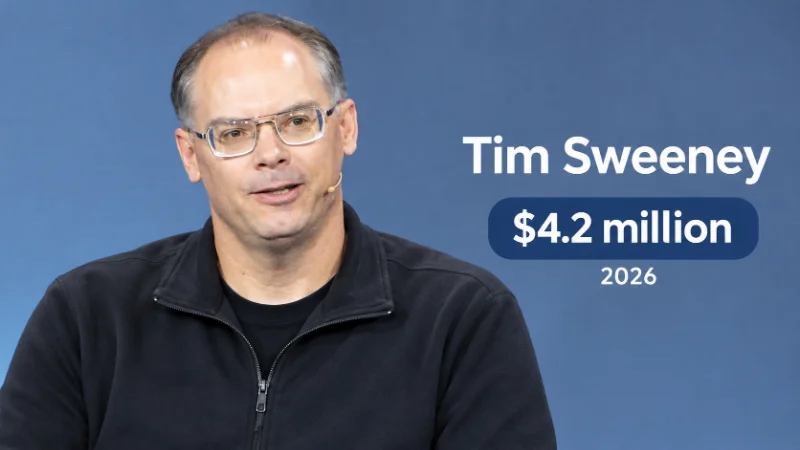
Tim Sweeney net worth is estimated at roughly $5 billion to $6 billion in recent public figures, though Forbes and Bloomberg put it at $7.6 billion and $9.6 billion back in 2022. Sweeney is the founder and CEO of Epic Games, the company behind Fortnite, Unreal Engine and the Epic Games Store. Nearly all of his money sits in one private company, which is why no two outlets land on the same number.
That gap is the real story. A programmer who once sold a game by mail for about $100 a day now holds a stake in a business that was valued at $31.5 billion in 2022, and he has used his wealth to buy about 50,000 acres of forest. This article covers the numbers, where they come from, and what could move them.
Tim Sweeney Net Worth at a Glance
The newest published figures cluster near $5 billion to $6 billion, while the 2022 readings sit well above that. Here is how the main sources compare.
| Source | Estimate | Basis |
| Celebrity Net Worth | $6 billion | About 20% of a company valued near $30 billion |
| Goodreturns | $5.08 billion | Ranks him 833rd among global billionaires |
| Traders Union | $5.1 billion | 2026 estimate from public sources |
| Forbes, May 2022 | $7.6 billion | Cited by Wikipedia |
| Bloomberg, 2022 | $9.6 billion | Cited by Wikipedia |
None of these are audited numbers. Epic Games is privately held, so outsiders never see its books or its full ownership table.
Why the Estimates Disagree So Widely
A public company’s market value moves with every trade. Epic has no ticker, so every outlet has to pick a valuation and a stake size by hand. That is where the numbers split.
Epic’s valuation has moved in steps. Reuters reported a $28.7 billion valuation after a funding round in April 2021, and Celebrity Net Worth reports that a $2 billion raise in April 2022 valued the company at $31.5 billion. Those round prices are the best public anchors for any estimate of Tim Sweeney net worth.
The stake is the second variable, and sources disagree on it. Celebrity Net Worth believes Sweeney owns about 20% of Epic. Wikipedia’s Epic Games entry lists him at 41.4%, followed by Tencent at 28%, Disney at 9%, Sony at 5.4%, Mark Rein at 4% and Kirkbi at 3.2%.
The difference matters. Applied to a $31.5 billion valuation, 20% is about $6.3 billion, which is close to the recent estimates. A 41.4% stake would come to roughly $13 billion, higher than any published estimate reviewed for this article. Epic has not confirmed either percentage, so the ownership split remains unverified.
Forbes and Bloomberg were $2 billion apart in 2022, according to Wikipedia, which shows how much room private-company math leaves. A practical way to read the range: treat $5 billion to $6 billion as the working figure today, and treat the 2022 readings as snapshots taken when Epic’s last round with a public valuation was fresh.
From a $100-a-Day Game to Epic MegaGames
Sweeney grew up in Potomac, Maryland, the youngest of three brothers. He taught himself to program as a kid, and by his own estimate spent more than 10,000 hours on it between the ages of 11 and 15. He also earned early money mowing lawns for wealthy neighbors at half the price of professional services.
At the University of Maryland, where he studied mechanical engineering, he started a consulting business called Potomac Computer Systems. It never took off. Then he wrote a text editor, turned it into a game called ZZT, and sold it by mail through the shareware model.

ZZT sold a few copies a day, roughly $100 in daily revenue, according to Wikipedia. That was enough for Sweeney to treat game development as a career. He renamed the company Epic MegaGames, a name he picked so a one-person operation would sound bigger, per Wikipedia’s Epic Games entry.
Jill of the Jungle came next, finished by a four-person team in mid-1992. Sweeney then brought in Mark Rein, who had just left id Software, to help run the business. The company grew fast enough that Sweeney never finished his degree, ending up one credit short.
The origin matters for the money. Epic began with mail-order sales, and Wikipedia still describes Sweeney as the controlling shareholder.
How Unreal Engine Turned a Studio Into a Platform
Sweeney started work on Unreal Engine for the 1998 shooter Unreal. Other developers licensed it for their own games, which gave Epic a second income stream beyond selling its own titles. The company moved to North Carolina in 1999 and became Epic Games.
Celebrity Net Worth says Sweeney wrote about 90% of the engine’s code. That figure is not independently verified, so treat it as a repeated claim.
Unreal Engine 3 later powered Gears of War, and Wired gave Sweeney a Rave Award in 2007 for that work. Between engine licensing and its own games, Epic had two revenue streams by the time Fortnite arrived.
Fortnite, the Epic Games Store, and the Valuation Surge
Epic announced Fortnite at the 2011 Spike Video Game Awards, and worked on it for years alongside People Can Fly, which it fully acquired in 2012. Its free-to-play Battle Royale mode drove the game’s rise. Epic launched the Epic Games Store in 2018. In 2024 it expanded to mobile, reaching Android worldwide and iOS in the European Union.

The money followed. Forbes ranked Sweeney 123rd on its 2020 Forbes 400 list, according to Money Inc, and named him Person of the Year at its 2020 Forbes Media Awards for turning Fortnite into a social network. Money Inc also reports that Epic raised $1.25 billion from outside investors, including Vulcan Capital and Kleiner Perkins.
The Tencent Deal
In 2012, Tencent bought a 48.4% share of Epic’s outstanding stock, which equaled 40% of the company in total, according to Wikipedia. Money Inc, citing Forbes, puts the price at $330 million. Celebrity Net Worth frames it as a deal at an $825 million valuation.
Set against the $31.5 billion valuation of April 2022, that 2012 price implies Epic grew about 38-fold in a decade. Tencent’s deal also came with an agreement aimed at moving Epic toward a games-as-a-service model, and Sweeney stayed the controlling shareholder.
Later Investors: Sony, Kirkbi, and Disney
The April 2022 round raised $2 billion from Sony and Kirkbi, the family office behind Lego, according to Mabumbe. Disney followed in February 2024 with a $1.5 billion investment and a plan to build a connected games and entertainment universe around Fortnite. Each new investor trims Sweeney’s percentage, but a higher valuation can still raise the dollar value of what he keeps.
Lawsuits and Layoffs: What They Mean for His Fortune
Sweeney has been willing to sue the companies that run the biggest app stores. In 2020, Epic added its own payment system to Fortnite to sidestep Apple’s commission, Apple removed the game from the App Store, and Epic sued. A federal judge ruled largely in Apple’s favor in September 2021 but ordered Apple to let developers point users to other payment methods.
The Google case went better. A federal jury unanimously found for Epic in December 2023, the Ninth Circuit upheld the main findings in July 2025, and in March 2026 Google settled by agreeing to lower its Play Store fees and allow more alternative billing and third-party app stores. Sweeney called the deal a victory for competition and openness on Android.
The more direct pressure on his net worth comes from Epic’s own results. In March 2026, Epic said it would lay off more than 1,000 employees after Fortnite engagement fell, according to Reuters. Sweeney said Epic was spending significantly more than it earned and expected the cuts, plus reductions in contracting and marketing, to save more than $500 million.
A newer Epic valuation has not been publicly confirmed, so the 2022 round price remains the latest anchor in most estimates. A lower valuation would cut a paper fortune quickly, because nearly all of it rests on one private company.
Where the Money Goes: Land Conservation in North Carolina
Sweeney has spent much of the past two decades buying forest. Wikipedia says that since the 2008 housing collapse he has purchased large tracts in North Carolina, and that by November 2025 he had bought 50,000 acres, making him one of the state’s largest private landowners.
He paid $15 million for the Box Creek Wilderness, a 7,000-acre area with more than 130 rare and threatened plant and animal species, then donated its conservation easement to the federal Fish and Wildlife Service in 2016. He also donated 1,500 acres toward the expansion of Mount Mitchell State Park.

The largest gift came in April 2021, when he announced a donation of 7,500 acres in the Roan Highlands to the Southern Appalachian Highlands Conservancy. The land was valued at tens of millions of dollars, and it is the largest private conservation land donation in North Carolina history, according to Wikipedia. The North Carolina Wildlife Federation named him Land Conservationist of the Year in 2013.
For anyone estimating his wealth, this matters. Land he buys and then gives away leaves his balance sheet, so an estimate built only on his Epic stake may overstate what he still holds. Sweeney’s salary from Epic is not publicly confirmed, so income figures found online should be treated as guesses.
How Sweeney Lives With His Wealth
Sweeney lives in Cary, North Carolina, the town Epic moved to in 1999. Kotaku once profiled him as a quiet tinkerer, and he told the outlet he had played few video games in his life and finished very few. Business Insider, as summarized by Money Inc, describes him as a regular guy who has kept his feet on the ground.
His technical side shows up in print too: he has filed software patents since 2006 and co-authored academic papers on programming languages, including a 2022 paper on the Verse Calculus.
Awards and Industry Standing
Sweeney entered the Academy of Interactive Arts and Sciences Hall of Fame in 2012 and received the Game Developers Choice Awards Lifetime Achievement Award in 2017. MCV named him Person of the Year in 2019, and Forbes did the same in 2020. Together, those honors show a career recognized by both the game industry and the business press.
What Could Move Tim Sweeney Net Worth Next
Epic’s next valuation is the biggest variable. A fresh funding round or a share sale would give outlets a new price to work from, and neither has been confirmed. Fortnite engagement also matters, since Reuters tied the March 2026 layoffs to falling usage.
Platform fees are another lever. Google’s lower Play Store fees and the Apple ruling on outside payment links give Epic more room to sell directly to players, and the Disney partnership gives Fortnite new content to build around. Whether those moves lift revenue is not yet public.
Land is the last variable. Each large donation moves land he paid for into conservation hands, so further gifts would trim what he still owns.